
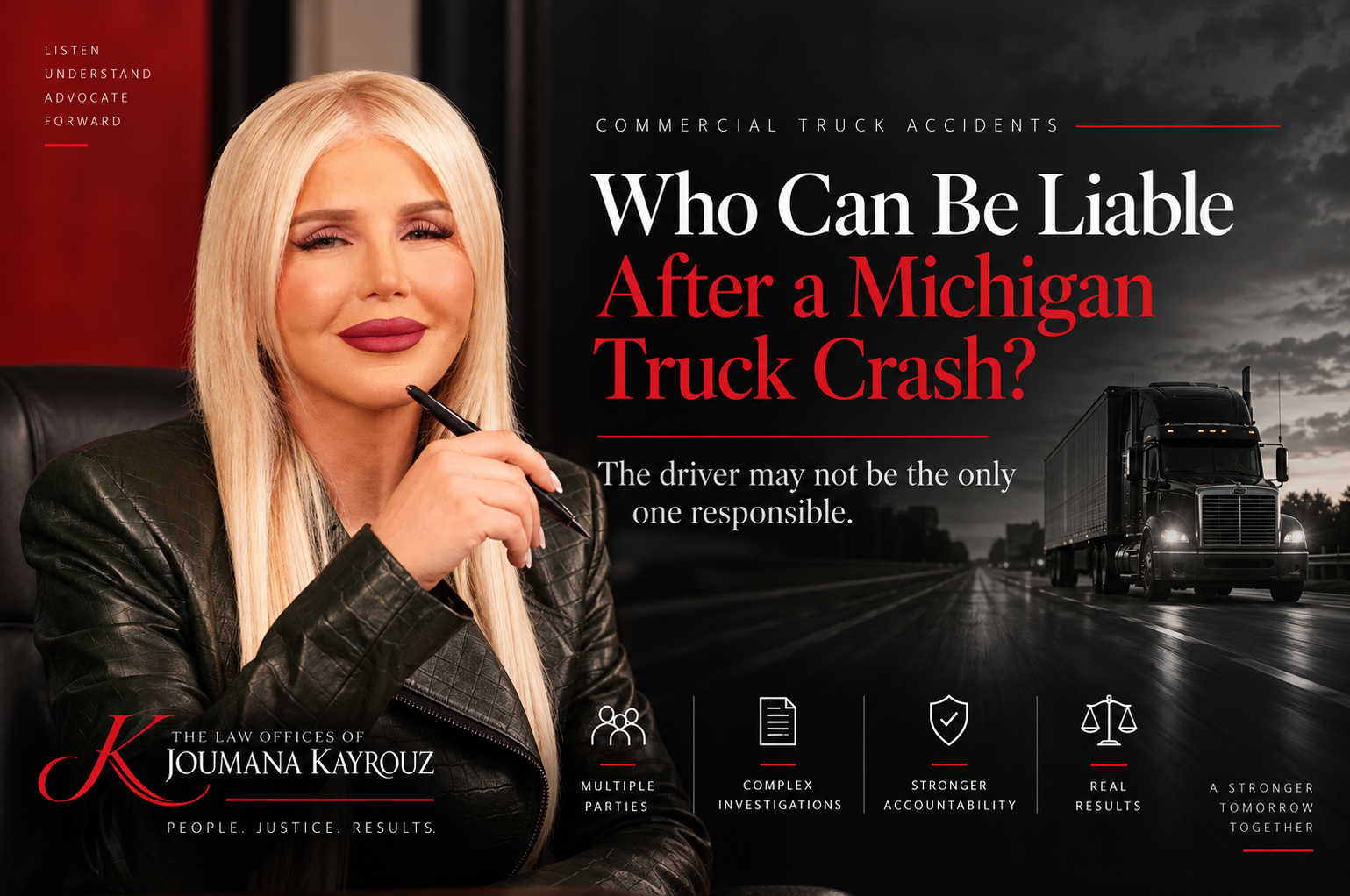
A semi-truck crosses into your lane.
A delivery vehicle does not stop in time.
A trailer loses cargo on the freeway.
A truck tire fails.
The first question may seem obvious:
What did the driver do wrong?
Sometimes that is exactly where the investigation begins.
It should not always be where it ends.
Commercial transportation involves people and businesses making decisions long before a truck reaches the place where a collision happens.
Someone hired the driver.
Someone trained or supervised that driver.
Someone scheduled the route.
Someone inspected the vehicle.
Someone maintained the brakes and tires.
Someone loaded the cargo.
Someone owned or leased the equipment.
And sometimes a defective component entered the chain before any of those people touched the truck.
That does not mean every company connected with a truck is legally responsible for every crash.
It means a serious commercial truck accident deserves a careful investigation of who did what, what went wrong, and whether that failure contributed to the collision.
At Joumana Law, that distinction matters.
Because identifying the driver is sometimes only the first step toward understanding what really happened.
Look Beyond the Driver.
A serious truck crash may involve decisions made hours, days, or even months before the collision.
Commercial Truck Crashes Are Not Just Bigger Car Accidents
A tractor-trailer can involve a commercial transportation operation with records, policies, equipment, maintenance responsibilities, and regulatory obligations that simply do not exist in most ordinary passenger-car cases.
Federal Motor Carrier Safety Administration regulations govern many interstate commercial motor-carrier operations, including areas such as driving time, vehicle maintenance, and cargo securement. The exact rules that apply depend on the carrier, vehicle, trip, and other circumstances.
That means a serious truck case may require questions that would never come up after an ordinary fender-bender.
For example:
- How long had the driver been working?
- What did the electronic driving records show?
- When were the brakes last inspected?
- Who repaired the truck?
- Was a known mechanical problem ignored?
- Was the cargo properly secured?
- Who loaded the trailer?
- What did the company know about the driver's history?
- Was the truck owned by the carrier or leased?
- Was a defective component involved?
The goal is not to make the case unnecessarily complicated.
The goal is to avoid making it artificially simple.
The Truck Driver May Be Responsible
A commercial driver can cause a collision for many of the same reasons any driver can.
That may include:
The driver's actions immediately before the crash are important.
But commercial driving also raises another question:
What conditions did the company place that driver in?
When Can the Trucking Company Matter?
A motor carrier may become important to an accident investigation in several different ways.
One is the traditional legal concept often called respondeat superior, under which an employer may be legally responsible for wrongful conduct committed by an employee within the scope of employment. The exact standard is jurisdiction-specific and depends on the employment relationship and facts.
There may also be separate questions about the company's own conduct.
Depending on the facts, those could include allegations involving:
Those theories are not automatic.
They require evidence.
That is exactly why the records behind a commercial operation can matter.
What If the Driver Is Called an “Independent Contractor”?
This is an area where words can be misleading.
A company may describe a driver as an independent contractor, owner-operator, or another business classification.
That label by itself does not answer every legal question.
For purposes of the federal motor-carrier safety regulations, the definition of an “employee” expressly includes a commercial motor-vehicle driver who is an independent contractor while operating the vehicle. That regulatory definition is designed for federal safety rules; it does not by itself decide state tort liability or employment status for every legal purpose.
That distinction is worth understanding.
A contractual label should not end the investigation before the actual relationships and responsibilities are examined.
Driver Fatigue Can Be More Than a Personal Decision
Commercial drivers work under time pressure.
Deliveries have schedules.
Customers have deadlines.
Routes take longer than expected.
Traffic backs up.
Weather changes.
And human beings still need sleep.
Federal hours-of-service rules generally allow a property-carrying commercial driver to drive up to 11 hours after 10 consecutive hours off duty, within a 14-hour driving window. A 30-minute break is generally required after eight cumulative hours of driving without a qualifying interruption, subject to applicable exceptions.
Those rules exist because fatigue can affect safe vehicle operation.
But an hours-of-service violation is not the only way fatigue can matter.
A driver can technically be within a regulatory limit and still be dangerously tired.
That is why evidence about the actual workday matters.
The Federal Driving Window, in Plain English
These are general federal hours-of-service limits. Exceptions and special rules can apply.
A qualifying 30-minute interruption is generally required before continuing to drive once the rule applies.
The time limits depicted in this visual reflect FMCSA’s current general hours-of-service summary for property-carrying drivers. (See more FMCSA's Regulations at https://www.fmcsa.dot.gov/regulations)
Maintenance Can Change the Liability Picture
A truck is not safe simply because its driver is careful.
Brakes have to work.
Tires have to be safe.
Steering components have to function.
Lights must operate.
Mechanical problems need attention before they become roadway emergencies.
Federal regulations require motor carriers to systematically inspect, repair, and maintain vehicles under their control and keep parts and accessories in safe and proper operating condition. FMCSA describes “systematic” maintenance as a regular or scheduled program for keeping vehicles safely operable.
After a crash involving suspected equipment failure, important questions may include:
- When was the truck last inspected?
- What repairs were recommended?
- Were those repairs completed?
- Were there previous driver complaints?
- Was a problem repeatedly patched instead of corrected?
- Who performed the maintenance?
- Were tires within safe condition?
- Did the carrier maintain required records?
A brake failure is not simply a “brake failure” if someone knew the brakes needed attention and sent the truck back onto the road anyway.
Can a Maintenance Company Be Responsible?
Potentially, depending on the facts.
Some carriers maintain their own fleets.
Others rely on outside mechanics, repair facilities, tire companies, or service contractors.
If negligent inspection or repair contributes to a collision, the work performed by a maintenance provider may become relevant.
Again, connection alone is not enough.
A maintenance company is not responsible simply because it once touched the truck.
The question is whether negligent work caused or contributed to the condition that caused the injury.
Cargo Can Become Part of the Crash
A truck's load affects how the vehicle handles.
Improperly secured cargo may:
FMCSA’s interstate cargo-securement rules require cargo to be immobilized or secured so that it does not shift or fall from the commercial vehicle, with additional requirements for particular commodities.
Depending on the operation, cargo may have been loaded by:
Who loaded it does not automatically determine legal responsibility.
But it tells investigators where to ask the next question.
What If the Truck Itself Was Defective?
Sometimes the problem starts before the carrier ever acquires the vehicle.
A case may raise product-liability questions involving components such as:
If a defective product contributes to a crash, the manufacturer, distributor, or another entity in the product chain may need to be examined under applicable product-liability law.
What About Freight Brokers, Shippers, or Other Businesses?
These cases require particular care.
A freight broker or shipper is not automatically liable simply because it arranged transportation or owned the cargo.
Potential responsibility depends on the specific relationship, conduct, contracts, control, applicable state law, and increasingly complex questions of federal law.
That means this is an area where sweeping statements should be avoided.
The proper question is not:
“Was a broker involved?”
It is:
“What did this entity actually do, what legal duty may have applied, and did its conduct contribute to the crash?”
That fact-specific approach matters.
Michigan Commercial Vehicle Crashes Are Not Rare
Michigan State Police's final 2025 data reported that commercial-motor-vehicle-involved fatalities increased from 110 in 2024 to 128 in 2025, a 16% increase.
Those numbers do not tell us who was at fault in any individual crash.
They do show why commercial vehicle safety remains an important roadway issue in Michigan.
Michigan State Police reported 110 commercial-motor-vehicle-involved fatalities in 2024 and 128 in 2025, an increase of 16%.
Source: Michigan State Police, final 2025 statewide crash data. A crash involving a commercial vehicle does not establish fault by itself.The figure above comes from MSP's August 2026 release of final 2025 crash data.
Truck Cases Often Have Evidence That Car Cases Do Not
A commercial truck crash may generate an unusually detailed paper and electronic trail.
Depending on the circumstances, relevant evidence might include:
Not every document exists in every case.
Not every document proves negligence.
But trucking cases often require looking behind the collision itself.
Why Acting Early Can Matter
Some evidence exists only because a business retains it.
Other evidence may be routinely overwritten, replaced, repaired, or discarded.
That does not mean people should panic after an accident.
It means serious cases deserve prompt attention to preservation.
For example:
A truck may return to service.
A damaged component may be repaired.
Electronic data may be overwritten.
Surveillance video may disappear.
Witnesses may become difficult to locate.
That is why early investigation can matter in a catastrophic commercial vehicle crash.
What May Need to Be Preserved?
A Truck Crash Can Cause Life-Changing Injuries
The difference in vehicle size and weight can leave people in passenger vehicles with severe trauma.
Commercial truck crashes may result in:
The legal investigation matters because the medical consequences can extend far beyond the first hospital stay.
A catastrophic injury may affect:
When a Michigan Truck Crash Is Fatal
Some commercial crashes leave families with questions no family should have to ask.
Why did this happen?
Was the driver too tired?
Was the truck unsafe?
Did someone ignore a warning?
Could this have been prevented?
Michigan wrongful death law may provide a civil claim when a death results from another party's legally actionable wrongful act, neglect, or fault.
A fatal trucking case may require examining not only the driver but the commercial operation behind the vehicle.
No lawsuit can restore the person who was lost.
But a family deserves the truth about what happened and whether preventable conduct caused it.
Who Can Potentially Be Investigated After a Truck Accident?
There is no universal defendant list.
Depending on the facts, an investigation may examine:
The Truck Driver
For unsafe vehicle operation or other negligent conduct.
The Motor Carrier or Employer
For potential vicarious liability or the company's own hiring, supervision, safety, dispatch, or maintenance conduct.
The Vehicle Owner or Leasing Entity
Where ownership, control, maintenance responsibility, or another legal duty is relevant.
A Maintenance or Repair Company
When defective maintenance or repair may have contributed.
A Cargo Loader
When negligent loading or securement is supported by the evidence.
A Manufacturer
When a defective truck, trailer, tire, brake, or other component may have contributed.
Other Commercial Entities
Only where their actual conduct and applicable law support a claim.
That final point matters.
The purpose of a truck investigation is not to name as many parties as possible. It is to identify the parties whose conduct actually contributed to the injury.
What Should You Do After a Serious Truck Crash?
Your health comes first.
When circumstances allow:
Get Medical Attention
Commercial truck collisions can cause serious injuries that may not be fully apparent at the scene.
Report the Crash
Law-enforcement documentation can become important.
Preserve Photographs and Video
Vehicle positions, road conditions, markings, cargo, damage, and surrounding areas may matter later.
Get Witness Information
Independent witnesses can be particularly important when commercial drivers and companies dispute what occurred.
Keep Your Documents
Save medical records, insurance correspondence, wage information, receipts, and other accident-related records.
Do Not Assume the Police Report Contains the Entire Case
A police report can be important, but a civil investigation may address company records and other evidence that was not part of the officer's immediate crash investigation.
Consider Legal Guidance Early in a Serious Case
Commercial evidence can be different from ordinary car-crash evidence, and some information may need preservation.
Truck Accident FAQs
Is the truck driver always responsible for a truck accident?
No.
A driver may be responsible, but other people or companies may also be relevant depending on the facts. A motor carrier, maintenance provider, cargo loader, manufacturer, or another party could potentially be involved if its conduct contributed to causing the collision.
Can the trucking company be liable for the driver's negligence?
Potentially. Employer or principal liability may arise under doctrines such as respondeat superior when applicable requirements are met. The analysis depends on the employment relationship, scope of work, and governing law.
Can a trucking company be responsible for its own negligence?
Potentially. Depending on evidence and applicable law, issues may include hiring, training, supervision, maintenance, dispatch, or other company conduct.
How long can a commercial truck driver legally drive?
Under the general federal rule for property-carrying drivers, a qualifying driver may drive up to 11 hours after 10 consecutive hours off duty and may not drive beyond the 14th consecutive hour after coming on duty. Exceptions and special rules can apply.
Does violating a trucking regulation automatically prove liability?
Not necessarily.
A regulatory violation may be important evidence, but civil liability still depends on the applicable law, causation, facts, and other legal requirements.
Who is responsible if cargo falls from a truck?
That depends on who had duties relating to loading and securement, what went wrong, and whether the failure caused the collision. Federal interstate rules require covered cargo to be properly immobilized or secured.
What happens if bad brakes caused the crash?
Investigators may examine the motor carrier's inspection and maintenance records, repair work, driver inspections, and potentially the work of outside maintenance providers. Federal rules require motor carriers to systematically inspect, repair, and maintain covered vehicles under their control.
Is an independent-contractor truck driver treated differently?
It can depend on the legal issue. Federal motor-carrier safety regulations include an independent-contractor CMV driver within the regulatory definition of “employee” while operating the vehicle, but that definition does not automatically decide state tort liability or every employment question. (https://www.law.cornell.edu/cfr/text/49/390.5)
What if someone died in the truck crash?
A fatal commercial vehicle collision may give rise to a wrongful death claim when the applicable legal requirements are satisfied.
Sometimes the Most Important Evidence Is Not at the Crash Scene
A photograph may show where the truck stopped.
It cannot tell you how many hours the driver had worked.
Vehicle damage may reveal the force of impact.
It cannot tell you whether a mechanic warned that the brakes needed repair.
A trailer may look intact after the collision.
It cannot tell you whether the cargo shifted before impact.
That information lives somewhere else.
In records.
In data.
In maintenance histories.
In company decisions.
In the choices made before the truck ever reached the road.
That is why serious commercial truck cases require more than asking:
“Who hit me?”
The better question is:
“What caused this crash, who contributed to it, and what could have prevented it?”
That approach reflects something central to Joumana Kayrouz's philosophy of personal injury law: accountability matters because the purpose is not only to address the harm already done. It can also expose unsafe practices that should not be repeated.
When the Other Side Has a Company Behind It, Investigation Matters
A person injured in a commercial truck crash may be recovering in a hospital while a carrier, insurer, claims administrator, and other businesses are already gathering information.
That imbalance is real.
You should not have to become a trucking-industry expert while recovering from an injury.
You should be able to focus on getting better.
And if negligence caused serious harm, the investigation should follow the evidence wherever it leads.
At Joumana Law, we fight hard, and we don't back down.
Not by assuming every truck crash is the same.
By asking the questions that matter.
You deserve more than a settlement. You deserve justice. Let’s get to work.
24370 Northwest Highway
Southfield, MI 48075
Helpful Resources
Federal Motor Carrier Safety Administration — Hours of Service
FMCSA Hours-of-Service Rules
Federal Motor Carrier Safety Administration — Cargo Securement
FMCSA Cargo Securement Rules
Michigan State Police — Traffic Crash Data
Michigan Traffic Crash Data
Report Safety Violations
Have you experienced safety, service or discrimination issues with a moving company, bus or truck company, including hazardous materials, or cargo tank facility?
- Call 1-888-DOT-SAFT (368-7238) from 8am‒8pm, Mon‒Fri EST
IMPORTANT: If this is a safety emergency, please call 911 immediately. The NCCDB complaint system is intended only for investigation of past events.
Legal Disclaimer
Every case is different. This article provides general educational information and is not legal advice. Responsibility for a commercial vehicle crash depends on the specific facts, relationships among the parties, contracts, applicable state and federal law, insurance coverage, and evidence. A company’s involvement in transporting, maintaining, loading, leasing, or arranging a shipment does not by itself establish liability. Speak with a qualified lawyer about your individual rights and any deadlines that may apply. Prior results do not guarantee a similar outcome.