
You are hurt in a car accident.
Then someone tells you Michigan is a “No-Fault state.”
That phrase sounds simple.
It is not.
For an injured person, Michigan No-Fault can mean medical bills coming from one source, wage-loss benefits coming from the same insurance system, a separate claim against the driver who caused the crash, and entirely different questions if the at-fault driver does not have enough insurance.
No wonder people get confused.
At Joumana Law, we believe injured people deserve explanations they can actually use.
So let’s strip away the insurance language and talk about what Personal Injury Protection, or PIP, may really mean after a Michigan car accident.
What Does Michigan PIP Cover?
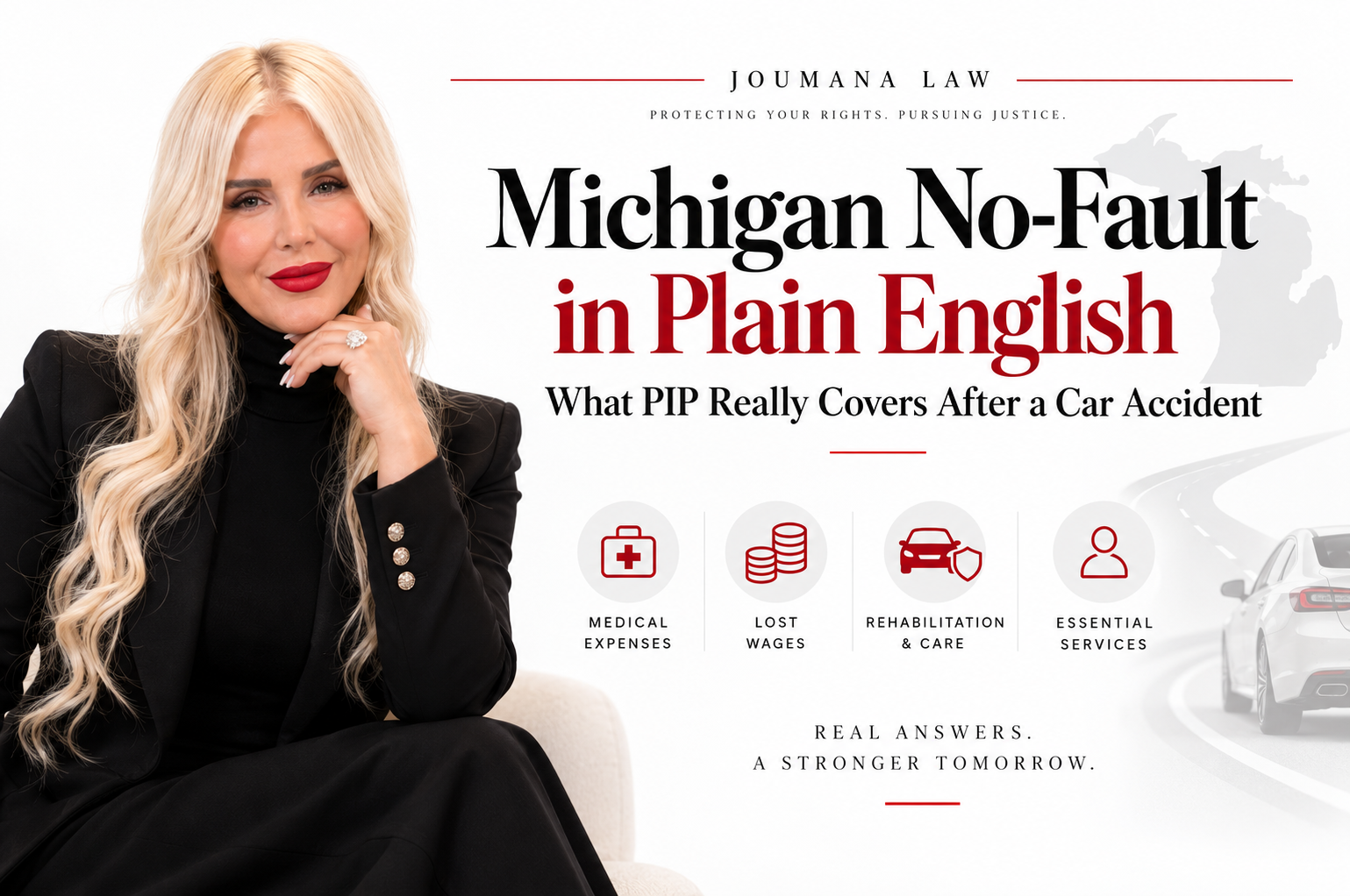
Michigan Personal Injury Protection can provide benefits after an auto accident without first requiring you to prove that another driver caused the crash.
Michigan DIFS explains that PIP medical covers allowable expenses for care, recovery, and rehabilitation, while wage loss and replacement-service benefits are separate parts of PIP.
First: What Does “No-Fault” Actually Mean?
The phrase No-Fault does not mean:
- nobody caused the accident;
- nobody can ever be sued;
- the insurance company automatically pays every bill;
- every injured person has unlimited medical coverage; or
- fault no longer matters.
At its simplest, Michigan’s No-Fault system allows certain accident-related benefits to be paid without first requiring the injured person to prove another driver was negligent.
That can matter enormously when someone needs treatment now, not months later after fault has been litigated.
But PIP is only one part of the picture.
Michigan auto policies also include other forms of coverage, and a seriously injured person may have a separate liability claim against the driver or another party responsible for causing the crash. Michigan law permits certain noneconomic-damage claims when an injured person suffers death, serious impairment of body function, or permanent serious disfigurement.
No-Fault does not mean “no responsibility.”
That distinction is one of the most important things an injured person can understand.
What Does PIP Medical Actually Pay For?
PIP medical is intended to address qualifying expenses connected with an injured person’s care, recovery, or rehabilitation.
Depending on the injury and available coverage, that may involve far more than an emergency-room bill.
Examples can include:
Michigan law describes allowable expenses as reasonable charges for reasonably necessary products, services, and accommodations for an injured person’s care, recovery, or rehabilitation.
That wording matters.
PIP is broad, but it is not a blank check.
An insurer may still question whether treatment is accident-related, medically necessary, properly documented, or within the injured person’s available PIP medical limit.
Michigan Drivers No Longer All Have the Same PIP Medical Limit
This is where many people still misunderstand Michigan law.
Michigan once had a system most people associated with unlimited lifetime medical benefits after an auto accident.
Today, drivers may select among six PIP medical coverage options, depending on eligibility.
Those options currently include:
- Unlimited PIP medical coverage
- $500,000 per person, per accident
- $250,000 per person, per accident
- $250,000 with certain permitted exclusions
- $50,000 for qualifying Medicaid households
- No PIP medical coverage for qualifying Medicare participants who meet the statutory requirements
The limited and opt-out options have eligibility requirements. An injured person should not assume which coverage applies based simply on remembering what was discussed when the policy was purchased.
The actual policy and coverage election matter.
Michigan DIFS currently lists these six coverage levels and explains the health-insurance requirements associated with the exclusion, Medicaid, and Medicare options.
Six Coverage Choices. Very Different Exposure.
Your available PIP medical benefits can depend on the coverage selected before the accident and whether the requirements for that option were met.
DIFS specifically notes that opting out of or excluding PIP medical does not automatically eliminate separate PIP benefits such as wage loss and replacement services.
PIP May Replace Part of Your Lost Income
A serious injury can make the financial pressure immediate.
Rent is still due.
The mortgage does not stop.
Groceries still need to be bought.
And an injured person may suddenly be unable to perform the job that supported the household.
Michigan PIP includes work-loss benefits for qualifying income the injured person would have earned during the first three years after the accident.
Michigan law generally reduces work-loss benefits by 15% because those PIP benefits are not taxable income, unless the claimant can establish a lower tax advantage. There is also a maximum benefit that is adjusted annually.
This is exactly the kind of detail that can get lost when someone hears only, “No-Fault pays your bills.”
It can provide important financial support.
But it has rules, documentation requirements, time limits, and caps.
What Are Replacement Services?
Imagine that before the accident you regularly:
- cleaned your home;
- cooked meals;
- did laundry;
- maintained your yard;
- handled ordinary household tasks; or
- performed other necessary services for yourself or your dependents.
Now your injuries prevent you from doing them.
Michigan PIP may provide replacement-service benefits for qualifying ordinary and necessary services someone else performs because the injured person cannot.
Under current Michigan law, those benefits are limited to up to $20 per day during the first three years after the accident.
Twenty dollars a day may not sound dramatic.
But for an injured family trying to hold daily life together, every available benefit matters.
And records matter.
If a family member, friend, or other person performs replacement services, keeping an accurate record of what was done and when can become important.
What About Attendant Care?
Some severe injuries leave a person needing help with basic personal care or supervision.
That is different from someone mowing the lawn or doing laundry.
Depending on the injuries, medically necessary attendant care may fall within PIP medical benefits.
This can become particularly important after:
Michigan has specific rules governing attendant care, including rules that can affect the number of hours an insurer must pay for certain care supplied by relatives, household members, or people who had a preexisting relationship with the injured person.
For families facing catastrophic injuries, this is not an area to reduce to a slogan.
It deserves careful review of the policy, medical needs, and applicable law. DIFS confirms that medically necessary attendant care is covered up to the applicable PIP medical limit, while also explaining current limitations affecting some family-provided care.
What PIP Does Not Mean
Understanding what PIP covers is only half of the equation.
It is equally important to understand what it does not automatically resolve.
PIP Is Not Pain-and-Suffering Compensation
PIP benefits address defined No-Fault losses.
They are not the same as a claim against the negligent person who caused a serious injury.
Michigan law permits certain tort claims for noneconomic loss when a motor-vehicle accident causes death, serious impairment of body function, or permanent serious disfigurement.
PIP Medical Does Not Necessarily Mean Unlimited Medical Coverage
If the policyholder selected a limited PIP medical amount, that dollar limit can matter.
DIFS specifically warns that when a lower PIP medical level is selected, the auto insurer’s medical payments are capped at that selected amount, and the injured person may potentially face expenses beyond it.
That is why reviewing the actual policy after a serious accident is important.
Do not rely only on what someone remembers choosing years earlier.
PIP Does Not Automatically Decide Who Caused the Crash
Your insurer may owe qualifying PIP benefits even though another driver caused the collision.
At the same time, evidence about who caused the accident may be crucial to a separate liability claim.
One accident can create both issues.
No-Fault Does Not Mean No Responsibility.
- Medical care and rehabilitation
- Work-loss benefits
- Replacement services
- Attendant care when applicable
- Who caused the crash?
- Does Michigan's injury threshold apply?
- What losses resulted?
- What insurance coverage exists?
These claims can overlap, but they are not interchangeable. Understanding the difference can prevent costly assumptions.
What If You Have Health Insurance?
This is another place people get surprised.
Health insurance and PIP medical coverage are not necessarily interchangeable.
Some Michigan drivers may rely on qualifying health coverage when selecting certain PIP options or exclusions. Medicare participants who meet the requirements may be eligible to opt out of PIP medical entirely.
But health plans have their own deductibles, covered services, networks, exclusions, and limits.
Michigan DIFS points out that PIP can cover certain accident-related services that Medicare may not typically provide in the same way, including services such as attendant care, transportation to medical appointments, case management, and certain long-term-care needs.
The lesson is simple:
Do not assume that “I have health insurance” answers every question about what will happen after a serious auto injury.
What Should You Keep After a Car Accident?
Insurance claims are built with documentation.
When possible, keep:
You do not need to become your own claims adjuster.
But preserving documents can prevent important information from disappearing.
Do Not Ignore Michigan's PIP Deadlines
Michigan No-Fault claims have deadlines.
Under current MCL 500.3145, an action for PIP benefits generally cannot be commenced more than one year after the accident unless written notice meeting the statute’s requirements was provided within one year or the insurer previously paid PIP benefits.
Different rules also govern how far back benefits may be recovered, and current law contains a tolling provision for certain periods after a specific claim is submitted and before the insurer formally denies it, provided the claimant pursues the claim with reasonable diligence.
That is too important to guess about.
If benefits are being delayed, disputed, or denied, do not assume you have unlimited time to deal with it.
Can You Still Bring a Claim Against the Driver Who Hit You?
Possibly.
This is one of the biggest misconceptions created by the phrase “No-Fault.”
Michigan No-Fault benefits and a liability claim are not the same thing.
If another person caused the crash and the injuries satisfy Michigan’s applicable legal standards, the injured person may have a separate claim involving damages outside PIP.
Michigan’s statute addresses noneconomic liability where a person has suffered death, serious impairment of body function, or permanent serious disfigurement. The serious-impairment analysis is highly fact-specific and considers whether an objectively manifested impairment of an important body function affects the person’s general ability to lead their normal life.
That is why the real question after a serious accident is not simply:
“Will No-Fault pay my bills?”
It is also:
“What has this injury taken from my life, and who may be responsible for causing it?”
What If the Other Driver Has No Insurance or Not Enough?
That creates another layer.
Your own policy may contain uninsured motorist or underinsured motorist coverage, depending on what coverage was purchased.
Those benefits are generally governed by the language of the insurance contract.
If the person who caused the crash has little or no liability coverage, UM or UIM coverage can become especially important in a serious injury case.
Five Things to Do When PIP Starts Feeling Complicated
1. Find Your Actual Policy
Do not rely on memory.
Find the declarations page and PIP medical selection information.
2. Keep Records From the Beginning
Document medical care, missed work, replacement services, insurer correspondence, and expenses.
3. Read Before You Sign
Do not sign a release or other document simply because it is presented as routine.
4. Pay Attention to Denials and Requests
An insurer may request medical documentation, wage verification, examinations, or other information.
Do not ignore correspondence.
5. Ask for Legal Guidance When the Injury Is Serious
A broken wrist and a spinal cord injury do not create the same long-term questions.
The more serious the injury, the more important it may be to understand the full picture before making decisions.
Michigan No-Fault FAQ
Does PIP pay medical bills even if I caused the accident?
PIP is designed to provide qualifying No-Fault benefits without first requiring proof that another driver caused the crash. Coverage still depends on eligibility, the policy, the injury, and applicable Michigan law.
Does PIP pay 100% of my lost wages?
Not necessarily. Michigan work-loss benefits are subject to statutory rules, including a general 15% reduction reflecting the tax-free nature of the benefits and an annually adjusted maximum.
How long can PIP pay wage loss?
Michigan law provides qualifying work-loss benefits for income the injured person would have earned during the first three years after the accident.
Does PIP pay for housekeeping?
Michigan law may provide up to $20 per day for qualifying ordinary and necessary replacement services during the first three years after the accident.
Does PIP pay for pain and suffering?
No. PIP benefits are different from a third-party claim for noneconomic damages against a legally responsible party.
Does everyone in Michigan still have unlimited PIP?
No. Michigan currently permits six PIP medical coverage options, including unlimited and several limited options, subject to eligibility requirements.
Can I sue the driver who caused my accident?
Potentially. Michigan law permits certain tort claims when statutory requirements are satisfied, including cases involving death, serious impairment of body function, or permanent serious disfigurement.
No-Fault Should Not Mean No Answers
After an accident, insurance terminology can make an already difficult situation harder.
You may be injured.
You may be missing work.
You may be worried about how your family will manage.
And now you are expected to understand PIP limits, medical coverage, replacement services, wage loss, liability claims, health insurance, and deadlines.
You do not have to pretend that is simple.
At Joumana Law, we believe injured people deserve to understand the system affecting their lives.
That begins with listening.
It continues with asking the right questions.
And when another person's negligence caused serious harm, it means looking beyond an insurance claim number and seeing the human being who has to live with what happened.
At Joumana Law, we fight hard, and we don't back down.
You deserve more than a settlement. You deserve justice. Let’s get to work.
24370 Northwest Highway
Southfield, MI 48075
Legal Disclaimer
Every case is different. This article provides general educational information about Michigan law and insurance and is not legal advice. Insurance coverage, benefits, deadlines, and legal claims depend on the policy, facts, date of loss, applicable law, and individual circumstances. Laws and insurance requirements can change. Speak with a qualified lawyer about your specific situation. Prior results do not guarantee a similar outcome.