
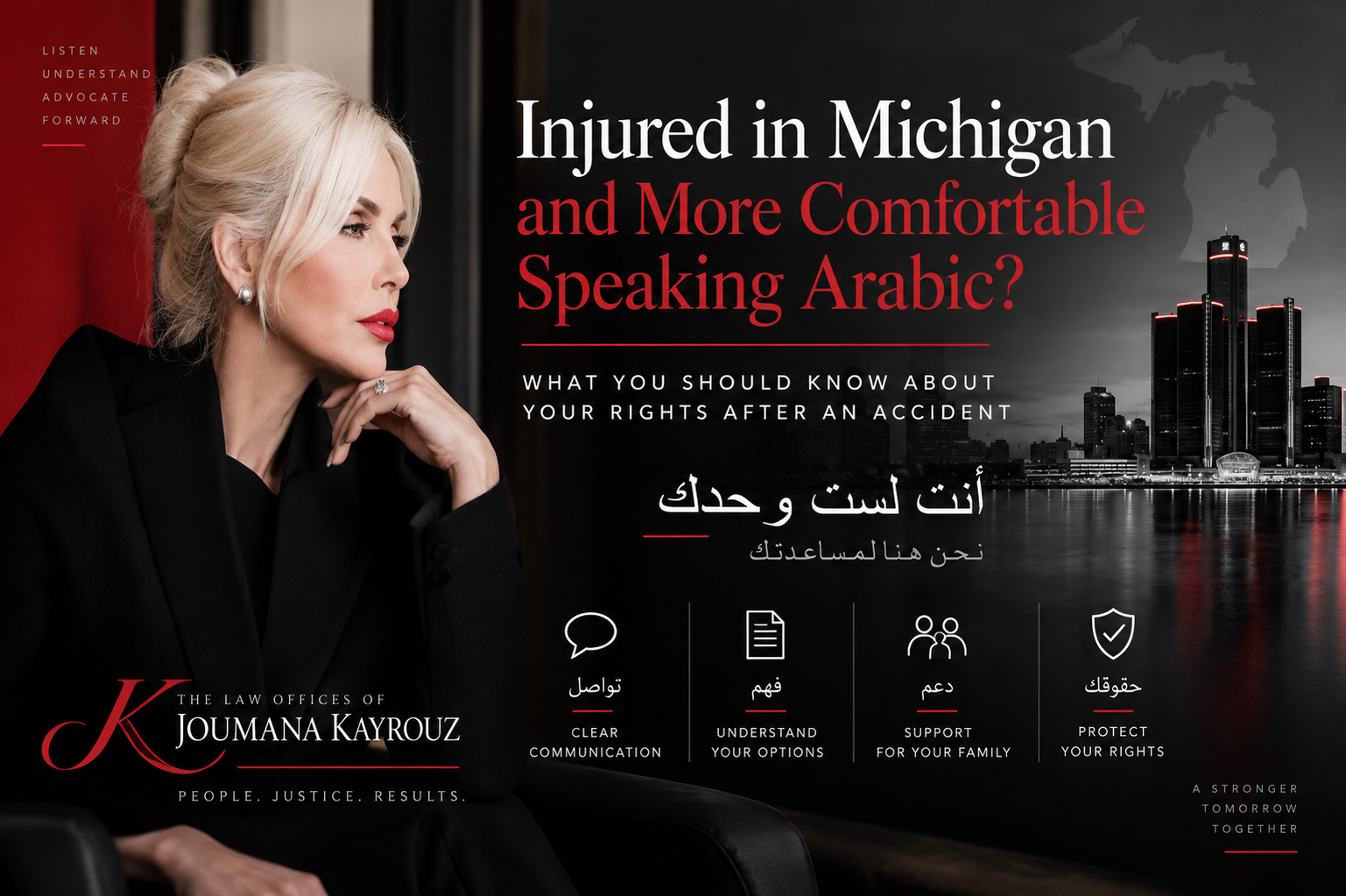
An accident is difficult enough when everyone is speaking the same language.
Add unfamiliar insurance terms, medical paperwork, legal deadlines, recorded statements, and documents written in formal English, and even someone who speaks English every day can feel overwhelmed.
For someone who is simply more comfortable discussing important matters in Arabic, those complications can become even more frustrating.
That does not make your case less important.
It means the information needs to be clear.
Joumana Kayrouz understands that personally.
Born in Lebanon, she later built her legal career in Michigan and is fluent in English, French, Italian, and several dialects of Arabic.
For decades, she has worked with Michigan families whose lives, languages, and cultures span more than one country.
And the principle is simple:
You should understand what is happening before you make decisions that affect your health, your family, or your legal rights.
An accident claim can involve insurance forms, medical records, deadlines, releases and legal terminology. You should not feel pressured to agree to something you do not understand.
اعرف حقوقك
اسأل حتى تفهم.
لا توقّع على مستند لا تفهمه، واطلب شرحًا واضحًا قبل اتخاذ قرار مهم.
The Arabic text reads essentially: Know your rights. Ask until you understand. Do not sign a document you do not understand, and ask for a clear explanation before making an important decision.
Speaking Arabic Does Not Change the Value of Your Injury
Your injuries are not more or less serious because English is not your first language.
Your lost wages do not matter less.
Your pain does not matter less.
Your need for treatment does not matter less.
And another driver, property owner, business, or corporation does not receive a different legal standard simply because the injured person feels more comfortable explaining what happened in Arabic.
A personal injury case is built around facts:
Language should help us understand those facts accurately.
It should not obscure them.
Do Not Sign Something Simply Because Someone Says It Is Routine
After an accident, paperwork can begin almost immediately.
You may receive:
Some forms may be necessary.
Some may have significant legal consequences.
The important point is this:
Do not treat a document as harmless simply because you were told, “Everybody signs this.”
If you do not understand what a document says, ask.
If English legal terminology is causing confusion, ask for help understanding it before signing.
A signature can have consequences regardless of what language you speak.
Your Story Needs to Be Accurate, Not Perfect English
One problem can arise when an injured person understands conversational English but struggles with medical or legal terminology.
For example, imagine someone is asked:
“Did you have any prior cervical symptoms?”
They may honestly answer “no” because they do not know that cervical refers to the neck in that medical context.
Or an insurance adjuster may ask:
“Were you experiencing any symptoms immediately following impact?”
The person may interpret that as meaning visible injuries rather than pain, dizziness, numbness, or confusion.
Small misunderstandings can create a record that looks inconsistent later.
That is why clarity matters.
If you do not understand the question, say so.
Ask the person to explain it differently.
There is nothing improper about making sure a question is understood before answering it.
Family Can Help, But the Injured Person's Voice Still Matters
In many families, especially close-knit immigrant and Middle Eastern families, an injury is rarely experienced by one person alone.
A spouse may attend appointments.
An adult child may help with insurance calls.
A brother, sister, cousin, or parent may help translate.
That support can be incredibly valuable.
But there is an important distinction between helping someone communicate and speaking for them about facts only they know.
The injured person may need to personally explain:
- What they remember about the accident
- Where they feel pain
- What symptoms began afterward
- What activities they can no longer perform
- How the injury changed work
- How the injury affects sleep
- What medical treatment helped or did not help
Those details belong to the injured person's experience.
A family member can support the process without replacing that voice.
After a Michigan Car Accident, No-Fault Insurance Can Be Confusing in Any Language
Michigan's auto-insurance system has its own vocabulary.
You may hear:
Even native English speakers regularly find these terms confusing.
Michigan's Department of Insurance and Financial Services recognizes the need for language access. Its official consumer-resource page currently provides several auto-insurance materials in Arabic, including information about Michigan's auto-insurance law, sample PIP medical forms, PIP opt-out information, and other consumer materials.
That is worth knowing.
Some Michigan Auto Insurance Information Is Available in Arabic.
Michigan DIFS publishes several official consumer materials in Arabic. These resources can help families understand important insurance choices and terminology.
View Michigan DIFS Consumer Guides →
Who Pays Medical Bills After a Michigan Auto Accident?
Michigan's No-Fault system can provide Personal Injury Protection benefits after qualifying motor-vehicle accidents.
Depending on the policy and circumstances, PIP can involve benefits related to:
But Michigan drivers can now have different PIP medical coverage levels.
The coverage selected before the accident matters.
So do the facts of the crash.
Read our Blog: Michigan No-Fault in Plain English
What If an Insurance Company Calls You?
An adjuster may call soon after the accident.
The conversation may sound friendly and informal.
Remember that it can still become part of the claim.
You do not need to be rude.
You also do not need to guess.
If you do not know an answer, say that you do not know.
If you do not understand a question, ask for clarification.
If you are not comfortable discussing an important insurance issue in English, say so and ask what language assistance may be available.
And if you are being asked to provide a recorded statement or sign something you do not understand, consider getting legal guidance before proceeding.
Medical Communication Matters Too
Your medical records may become some of the most important documents in a personal injury case.
That means your healthcare providers need to understand what you are experiencing.
Do your best to clearly report:
- Where you hurt
- When symptoms began
- Whether symptoms have changed
- Whether you have numbness or tingling
- Whether you feel dizzy
- Whether you lost consciousness
- Whether you are having memory problems
- What activities now cause pain
- Whether you are missing work
- Whether you can sleep normally
Do not exaggerate.
Do not minimize.
Be accurate.
If language makes medical communication difficult, ask the provider what interpretation or language-assistance resources are available.
Keep Your Own Records
After an accident, information starts moving quickly.
Insurance companies create files.
Hospitals create files.
Police create reports.
Employers create absence records.
You should preserve your own information too.
Keep copies of:
If an important document is in English and you do not understand it, do not simply file it away.
Find out what it means.
If Your Case Goes to Court, Michigan Has Rules for Foreign-Language Interpreters
This is one area where Michigan law provides a specific language-access protection.
Michigan Court Rule 1.111 requires a Michigan court to appoint a foreign-language interpreter for a party or witness with limited English proficiency when the court determines interpreter services are necessary for the person to meaningfully participate in the proceeding.
Michigan courts also have language-access coordinators and interpreter procedures intended to help limited-English-proficient individuals participate meaningfully in court.
That does not mean every interaction with an insurer, medical provider, or private company automatically carries the same interpreter rule.
Court proceedings are a specific legal setting.
But if a personal injury case reaches court and language assistance is necessary, the Michigan court system has a formal process for addressing it.
Clear Communication Matters at Every Stage.
- 01At the SceneGive accurate information. Preserve photographs, witnesses and other evidence when possible.
- 02Medical TreatmentMake sure healthcare providers understand your symptoms, limitations and medical history.
- 03Insurance ClaimsUnderstand forms, questions, statements and documents before responding or signing.
- 04Legal EvaluationExplain what happened in the language and manner that lets you communicate most accurately.
- 05Court, If NecessaryMichigan courts have formal interpreter rules for qualifying parties and witnesses.
Culture Can Affect How People Talk About Injury
This deserves to be discussed carefully.
Families communicate differently.
Some people are very comfortable discussing pain.
Others were raised not to complain.
Some people immediately seek medical help.
Others wait because they believe the pain will pass.
Some families make important decisions together.
Others value privacy.
None of those approaches automatically determines whether someone has a legal claim.
But they can affect how injuries are documented and communicated.
For example, someone who repeatedly tells a doctor:
“I'm fine. It's nothing.”
may simply be trying to remain strong.
But a medical record may later read as though that person was experiencing no significant problem.
Being honest about pain is not weakness.
Being accurate about what you can and cannot do is important.
Do Not Let Respectfulness Turn Into Silence
Many people do not like challenging authority.
That may include doctors, insurance adjusters, employers, or even attorneys.
But this is your injury.
You are allowed to ask:
What does this mean?
Why are you asking me to sign this?
What happens if I agree?
What benefits does my policy provide?
Why was this bill denied?
What is the deadline?
What happens next?
A professional should be able to explain an important issue clearly.
What If a Family Member Died in the Accident?
A fatal accident creates an entirely different level of grief and legal complexity.
Michigan's wrongful-death law may apply when a death results from another party's legally actionable wrongful act, neglect, or fault.
Families may be dealing with:
No legal process can replace the person who was lost.
But families deserve to know what happened and whether the law provides a path to accountability.
Why This Matters Personally to Joumana
For Joumana Kayrouz, multilingual representation is not something invented for a marketing campaign.
Her own life crossed countries and languages before her legal career ever began.
She was born in Lebanon and later came to the United States. Her professional biography states that she now speaks several Arabic dialects as well as English, French, and Italian.
That experience does not mean every Arabic-speaking client has the same story.
They do not.
The Arab and Middle Eastern communities in Michigan include people from different countries, religions, dialects, immigration histories, generations, and family traditions.
No community should be treated as though everyone inside it is the same.
What matters is something simpler:
The person sitting across the table should be heard accurately and treated with dignity.
That principle fits directly with the firm's stated brand values of strategic thinking and compassionate care.
Questions Arabic-Speaking Accident Victims Often Ask
Do I have to speak perfect English to bring a personal injury claim?
No.
The legal merits of an injury claim are based on the facts and applicable law, not whether someone speaks English as a first language.
Can my family member translate for me?
A family member may be helpful in many informal situations, but important medical or legal communications sometimes require greater precision.
If something significant is being discussed, make sure the communication is accurate and that you personally understand it.
Does Michigan provide auto-insurance information in Arabic?
Yes. Michigan DIFS currently publishes several official consumer auto-insurance resources in Arabic, including PIP-related materials.
Can I ask questions before signing an insurance form?
Yes. You should understand what you are signing.
If you do not understand a document, ask what it does and consider obtaining legal guidance before signing something that may affect your claim.
Can I use an interpreter in a Michigan court?
Michigan courts must appoint a foreign-language interpreter for a party or witness with limited English proficiency when the court determines those services are necessary for meaningful participation in the proceeding.
What if the insurance adjuster calls me in English?
If you do not understand a question, say so.
Do not guess simply to keep the conversation moving.
You can also ask the insurer what language-assistance options may be available.
What if I already signed something I did not understand?
Do not assume what the effect will be.
Keep a copy and speak with a lawyer who can review the actual document and circumstances.
What if I was partly responsible for the accident?
That does not automatically answer whether you have a claim.
Michigan comparative-fault rules can affect recovery, and the analysis depends on the particular facts and type of damages involved.
You Should Never Feel Embarrassed to Ask for an Explanation
Legal and insurance systems create their own language.
Sometimes even lawyers have to stop and carefully read what an insurance policy means.
There is no reason an injured person should feel embarrassed because a technical phrase does not make sense.
Ask again.
Ask for the document.
Ask what the deadline means.
Ask what happens next.
Understanding your case is not a courtesy.
It is part of making informed decisions about your own life.
When You Need Someone Who Understands More Than the Paperwork
An injury can leave you dealing with pain, uncertainty, lost income, medical treatment, and a system you never expected to enter.
Language can make that harder.
Culture can affect how comfortable someone feels asking questions.
And family responsibilities can make everything feel heavier.
Joumana Law understands that legal representation begins with listening.
Not making assumptions.
Not putting people into boxes.
And not treating an injured person like a number in an insurance system.
If you or someone you love has been injured in Michigan and would feel more comfortable communicating in Arabic, we want you to be able to tell your story clearly.
At Joumana Law, we fight hard, and we don't back down.
You deserve more than a settlement. You deserve justice. Let’s get to work.
24370 Northwest Highway
Southfield, MI 48075
Helpful Resources
Michigan DIFS — Consumer Guides and Arabic Auto Insurance Materials
Michigan Auto Insurance Consumer Guides
Michigan Courts — Foreign-Language Interpreter Rules
Michigan Court Rule 1.111
Legal Disclaimer
Every case is different. This article provides general educational information and is not legal advice. Legal rights, insurance coverage, deadlines, language-access requirements, and potential claims depend on the facts, applicable law, policy language, and forum involved. Language-assistance rights vary depending on the setting. Speak with a qualified attorney about your individual circumstances. Prior results do not guarantee a similar outcome.